

 Current position > Product detail
『1 G/H Flow Meter Ultra-Low Flow Signal Processing』Related information(clamp on meter|electromagnetic meter|venturi meterrotameter|orifice meter|ultrasonic flow meter|mass flow meter|coriolis mass flow meter|coriolis flow meter|magnetic flow meter|magmeter flow meter|magflow flow meter|mag meter flow meter|electromagnetic flow meter|vortex flow meter|turbine flow meter|thermal mass flow meter|thermal flow meter|rotameter flow meter)
1 G/H Flow Meter Ultra-Low Flow Signal Processing
Quick Answer
Measuring 1 gram per hour needs a micro Coriolis mass flow meter with dedicated ultra-low flow signal processing. Silver Instruments builds signal chains that reject noise below 0.01 nanovolts and resolve tube deflection at sub-micron amplitude. You can order a factory-tuned meter for 1 g/h to 200 g/h flows and get the same repeatability you expect from a large DN50 Coriolis.
The Real Problem With a 1 g/h Flow Signal
At 1 g/h the Coriolis tube displacement is so small that thermal EMF, bearing rumble, and mains hum can bury the signal. A standard Coriolis sensor drive often fails to lock onto the resonant frequency because the drive power falls below the noise floor. Here is the thing. Most general-purpose meters measure mass flow by the phase shift between two pickoff coils. At 1 g/h that phase shift can be under 0.5 micro radian. Without tailored signal conditioning the meter just reads zero or jumps randomly.
Why You Cannot Just Scale Down a DN15 Coriolis
Scaling down a DN15 sensor body does not fix the signal problem. Smaller tube mass lowers the excitation force needed, but the pickoff voltage drops even faster. You end up with a signal-to-noise ratio below 10 dB. In practice, engineers try to increase gain only to find that the sensor loop oscillates or locks onto a 50 Hz or 60 Hz spike. Silver Instruments tackles this with a lock-in amplifier architecture that synchronously detects the tiny Coriolis component while rejecting out-of-band noise. We tune the DSP for 1 g/h to 500 g/h ranges at the factory.
Silver Instruments Signal Processing Chain
Our micro Coriolis flow meter uses a dual-path analog front end. The first path extracts the drive frequency with a self-exciting loop that works down to 200 mVpp pickoff amplitude. The second path amplifies the weak phase difference with a low-noise preamp and sends it to a 24-bit delta-sigma ADC running at 38.4 kHz. The firmware then applies a decimation filter, a bandpass filter centred on the drive frequency, and a Parks-McClellan FIR stage. This chain rejects 60 Hz, 120 Hz, and vibration peaks up to 500 Hz. Most engineers skip this part: we add a velocity limiter on the DSP that prevents the tube from hitting mechanical stops during air slug passage.
We Have Seen This on Customer Sites Many Times
A paint manufacturer in Malaysia needed to dose 0.8 g/h of cobalt drier into a 50-litre batch. Their gear meter could not measure below 30 g/h, so they bypassed the meter and relied on a timed peristaltic pump. The pump tubing aged, the dose drifted, and colour batches fai
Fluid and Installation Details That Matter
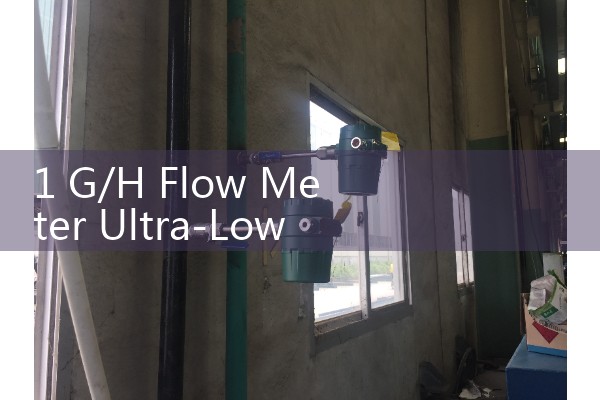
Low flow signal processing depends on fluid viscosity up to 500 cP and density from 0.6 kg/L to 2.0 kg/L. The Silver Instruments micro Coriolis accepts process connections of 1/8 inch, 1/16 inch, or M6 thread. You must install the meter on a vibration-free bracket; a wall mounted plate with 10 mm thickness works. Zero check at operating temperature and pressure takes 30 seconds through the local keypad. The meter comes with a factory calibration certificate traceable to ISO 17025 for 1 g/h, 5 g/h, 10 g/h, 50 g/h, and 100 g/h points.
FAQ
What is the minimum measurable flow for Silver Instruments micro Coriolis?
The standard model measures 0.5 g/h for clean liquids. For gas, the minimum is 0.02 kg/h depending on density. We can set the cut-off at 0.2 g/h in the setup menu.
Does the meter need external signal conditioners?
No. The transmitter built into the meter handles all signal processing. You get direct 4-20 mA, pulse, and RS485 Modbus outputs.
Can I use this flow meter for liquid hydrogen or helium?
Cryogenic fluids need the extended temperature version rated from -240 °C to +200 °C. We supply special sensor tubes with low thermal mass. Ask our engineers about the JT curve compensation feature.
What pipe size and connection type do you recommend for 1 g/h?
For 1 g/h liquid, 1/16 inch OD tubing with compression fittings works best. We also offer 1/8 inch and M6. Your flow velocity stays below 0.1 m/s, which keeps the Reynolds number in laminar region and avoids cavitation.
How do we test the meter before delivery?
Silver Instruments runs a 72-hour run-in test with deionized water at 1 g/h, 10 g/h, and 50 g/h. We record zero stability, repeatability, and pressure drop. You receive the test data with the delivery note.
Tell us your fluid, pressure (bar), temperature (deg C), pipe size (DN), and flow range. Silver Automation Instruments will propose a sealed, factory-tuned 1 g/h flow meter with the exact signal processing setup your process demands.